Where is the problem really? What litmus paper teaches us about a child's behavior
An outburst, rudeness or a fight is not the problem itself. It's the sign that shows us where to look, and where we, the parents, can do something differently.
 Yochai Leshem, clinical social worker and lecturer in child development · 4 min read
In one minute
- A child's behavior is not the problem itself. It's a sign that shows where the problem is.
- Punishing only the behavior is like throwing away the litmus paper, and drinking from the glass.
- The 80/20 rule: 20% of the energy goes on the child, 80% on us. The question is "What is this showing me, and what can I do differently as soon as tomorrow?"
Three glasses in a chemistry lesson
I remember one chemistry lesson. Our teacher, Danny, put three glasses on the table, all clear, all looking exactly the same. "One of them has poison in it," he said. "Who's willing to come up and drink?"
Nobody got up. How could you know you wouldn't pick the glass with the poison?
Then he handed out strips of white paper, litmus paper. When you dip it into the glass with the poison, it turns blue. One of the kids took a strip, dipped it into each glass, and within seconds we could all see which glass was dangerous, and which two were safe to drink.
The lesson
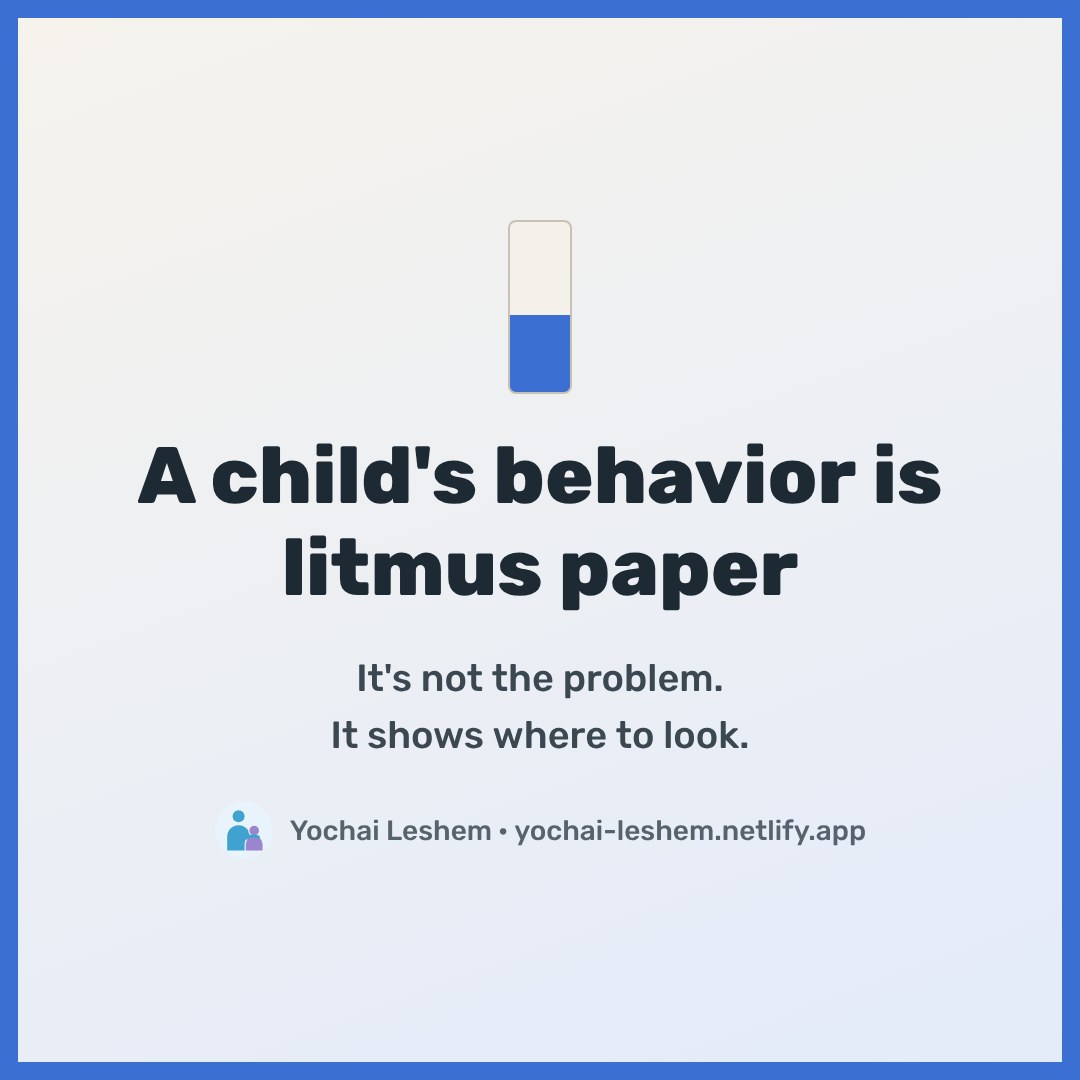
Very often, a child's behavior is the litmus paper. The problem isn't the paper. The paper just shows where the problem is.
A child who explodes, talks back, fights with his siblings or runs away from homework "turns blue". And that's exactly the information we need. The behavior points to a place where something isn't working: in the routine, the limits, the relationship, the load or the expectations. And it shows where we, the parents, can do something differently, as soon as tonight or tomorrow.
Two ways to respond
Treating the paper
- Punishing the behavior
- Trying to "turn the paper white again"
- The behavior disappears for a while, then comes back
- The glass with the poison stays on the table
Checking the glass
- Asking what the behavior is trying to show
- Looking for a pattern: when, where, after what
- Changing something around the child or in how we act
- The behavior fades, because the cause was dealt with
The 80/20 rule: where to put your energy
The economist Vilfredo Pareto noticed that many things in the world split in a ratio of 80 to 20. I see this ratio in parenting too. Most parents put nearly all their energy into the child: explaining to him, punishing him, persuading him. In other words, into the litmus paper.
But the paper is only there to reveal. Most of our energy is better spent on the glass: on what we do, the environment we create, the way we respond. And that's also the part that's in our control.
What the paper might reveal
A few examples from my practice. It isn't always the answer, but it's the place to start looking:
Three questions to dip the paper in
What time, what day, what place. A repeating pattern is a clue.
What happened in the minutes before? A transition, a demand, a screen turned off, a sibling walking in?
Not "how do I make him stop", but what will I do differently tomorrow.
It helps to write it down. After a week of short notes, the pattern almost always shows itself.
It's not about blame
When the paper turns blue, it doesn't mean the parents "did something wrong". Our teacher Danny didn't ask who put the poison in the glass. He just taught us how to spot it. It's the same here: the goal isn't to find someone to blame, but to know where to make a change. And the good news is that in most cases, a small change in us makes a big difference in them.
Save and share
Want to learn how to read the paper?
My Tantrums course includes a tool called the storm diary: half a minute of notes after each outburst, which within a week reveals the pattern, and what you can change.
Go to the Tantrums course