You can't order a child to make peace
Children don't need a judge. They need tools and awareness. About Peace Valley, six animals, and a new language children can learn.
 Yochai Leshem, clinical social worker and lecturer in child development · 4 min read
In one minute
- "Just make up already!" doesn't work, because we're asking children for something nobody taught them.
- When the parent is the judge, someone always loses. Children need a guide, not a judge.
- Six animals from Peace Valley give a child six skills, in order: from the storm all the way to making up.
Evening. Two siblings, one remote. Within a minute there's shouting, shoving and tears. And we say what every parent has said a thousand times: "Enough! Just make up already!"
It works for a few minutes, and then it starts again. Because it's like throwing a child into the water and shouting "Swim!" when nobody ever taught them how.
Peace isn't an instruction. It's a skill, and skills have to be taught.
Peace Valley is a method developed by Yochai Leshem. With it, children learn to move from conflict to cooperation with the help of six animals, each with a tool of its own.
Children don't need a judge
The parent as judge
- Finds out who started it and rules
- One wins, one loses
- The loser waits for the next round
- Children learn: the solution comes from above
The parent as guide
- Holds the frame and keeps everyone safe
- Gives tools, not a verdict
- Both leave with a solution
- Children learn: we can do this
Why we calm down first
In the middle of a fight, a child doesn't really hear us. The brain's alarm system "closes the stairs" to the thinking part. That's why explanations in the middle of a storm just don't get in.
The narrow bridge
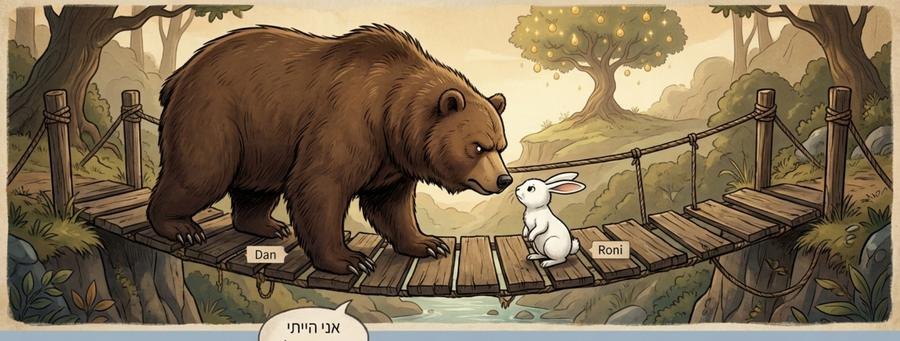
The narrow bridge is every fight: over the remote, the seat by the window, the last piece of cake. Fights are part of life. The question is how to cross the bridge without both of them falling into the water. In the story, six animals come to help, and each one brings one tool.
The path: from animal to animal
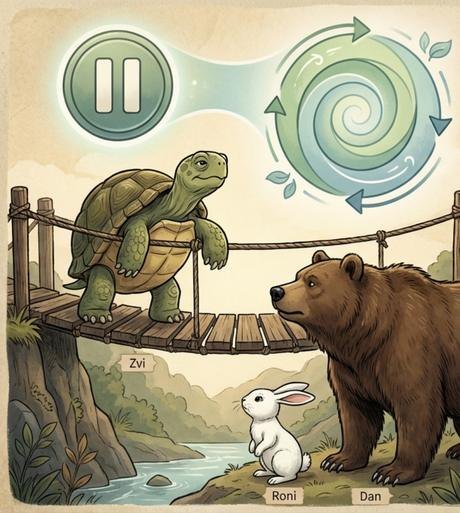 ZviCalm down
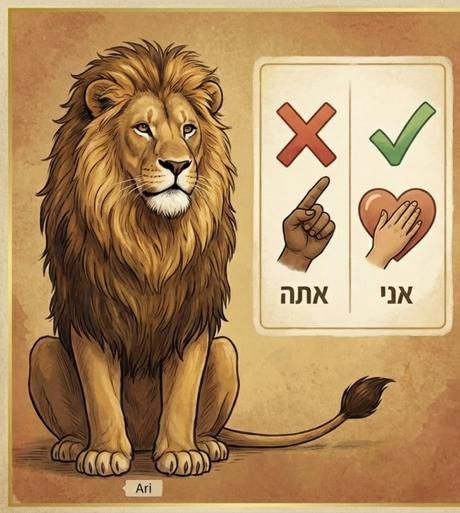 AriSay what you feel
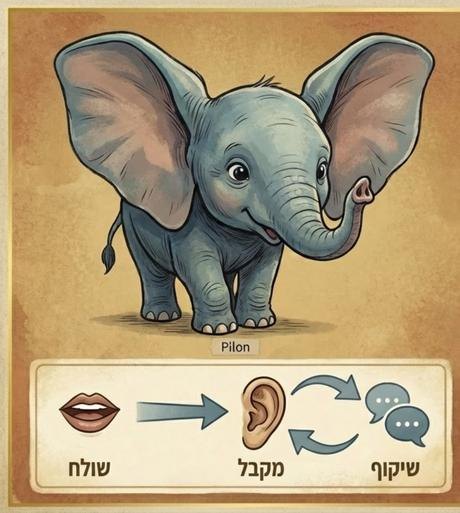 PilonListen and repeat
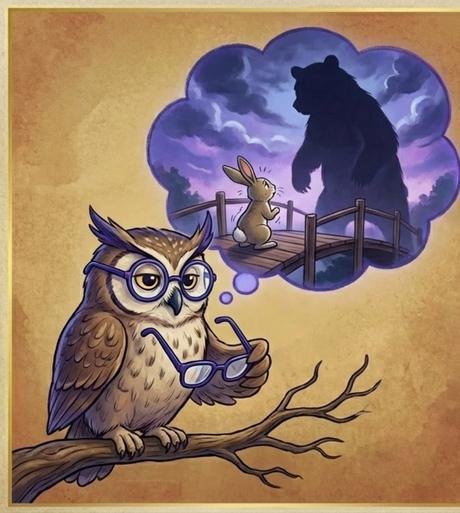 ShufiSee the other side
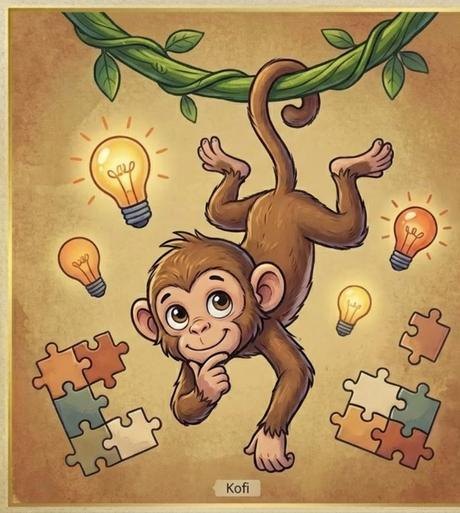 KofiFind a fix for both
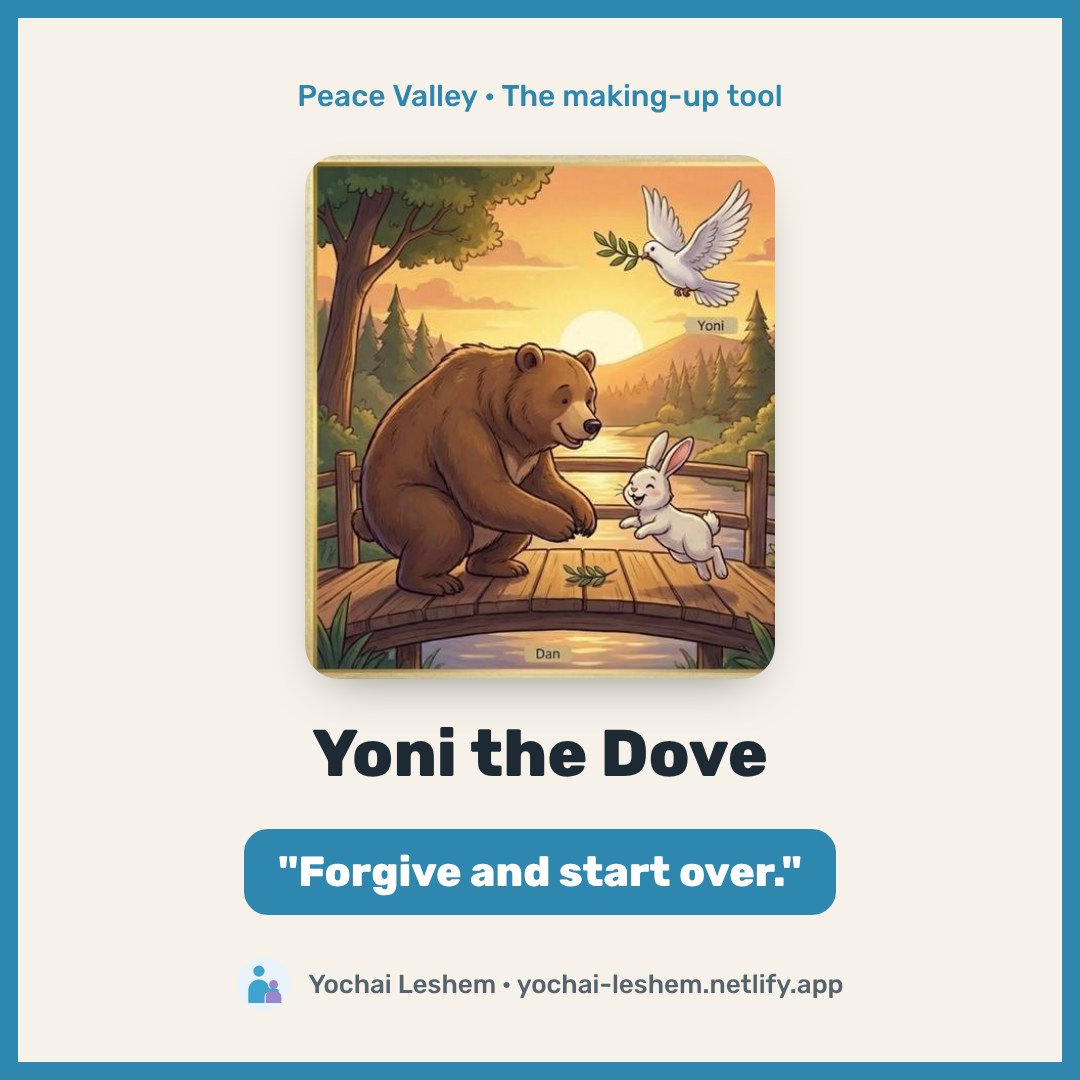
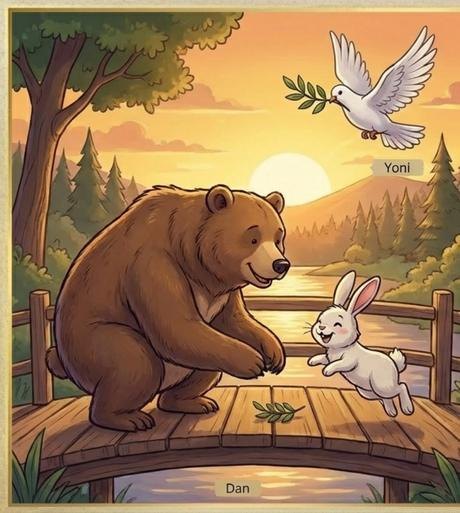 YoniForgive and start over
The order isn't random. You can't look for solutions while you're still boiling, and you can't understand the other side before someone has understood you. If they're still shouting, don't talk about solutions. Call the turtle.
The six animals
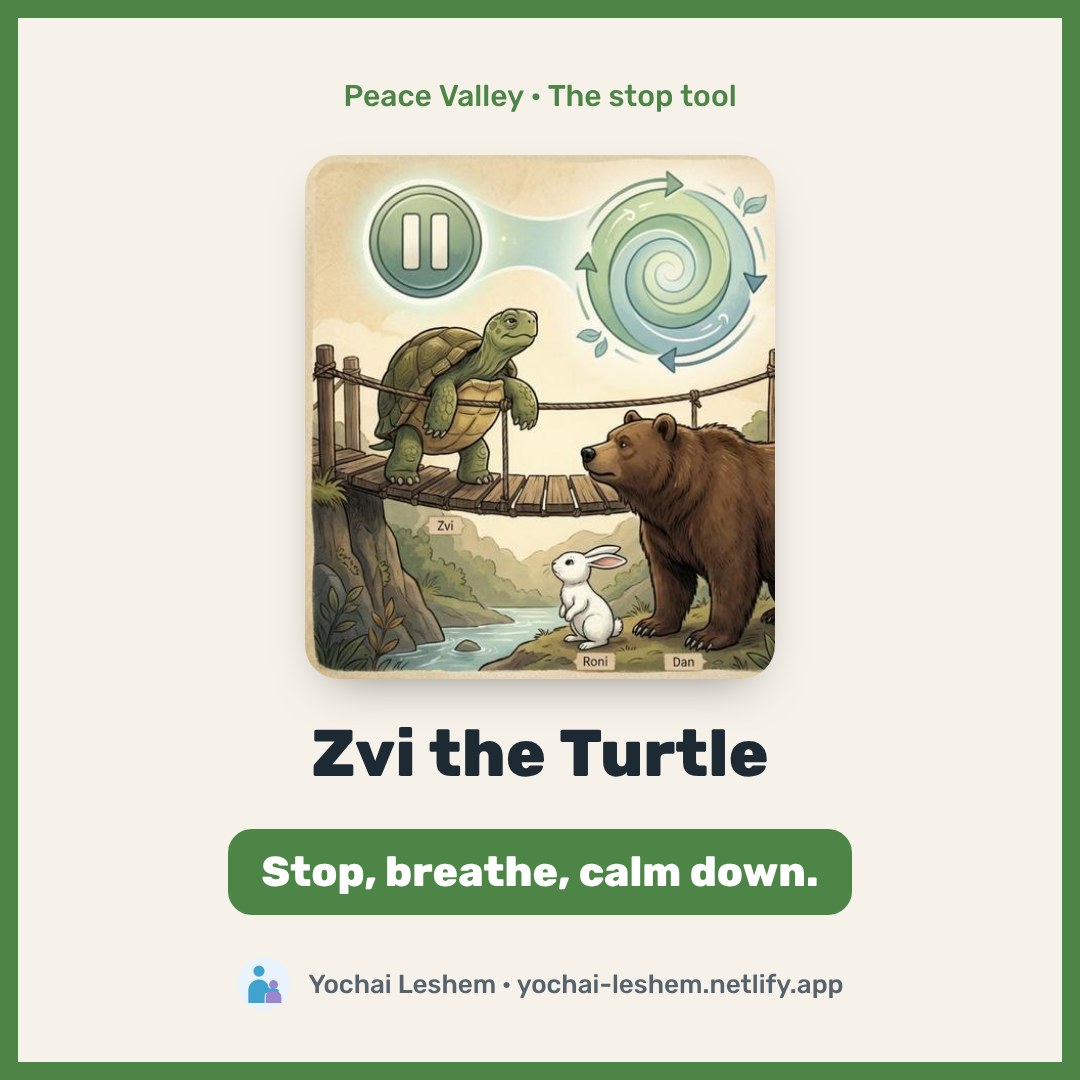
Zvi the Turtle
The stop toolStop, breathe, calm down.When we're angry, the brain is in a storm. You can't talk, listen or think when your heart is pounding as hard as it can. The turtle teaches the first and most important thing of all: before you answer, go into your shell. A hand on your tummy, a deep breath, count to ten. Only once the body has calmed down can you move on to the next animal.
In the middle of a fight: "I can see we're on the narrow bridge. Let's be like Zvi the Turtle for a moment, stop and breathe."
Practice at home: Turtle breathing at dinner: breathe in through the nose for four, hold for two, and breathe out slowly through the mouth, like blowing up a balloon.
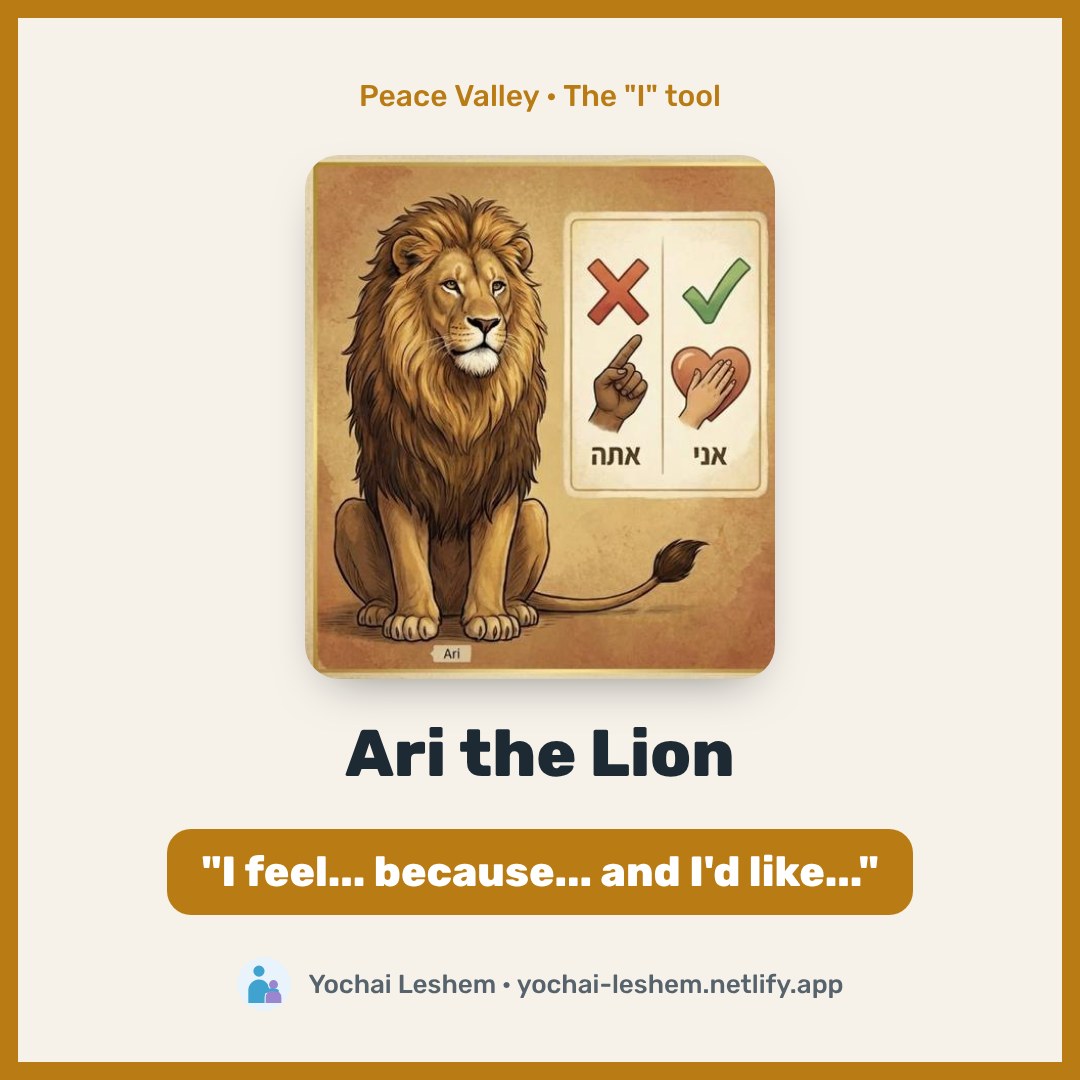
Ari the Lion
The "I" tool"I feel... because... and I'd like..."A real lion doesn't need to roar. He's strong enough to say what he feels without hurting anyone. Instead of "You're so annoying" and "You always take my stuff", the child learns to talk about himself: what I feel, why, and what I'm asking for. A sentence like that doesn't invite an attack back, so it opens the door.
In the middle of a fight: "Say it like Ari: 'I feel... because...', without blaming."
Practice at home: The switch game: the parent says a blaming sentence, like "You always take my things!", and the children turn it into a lion sentence.
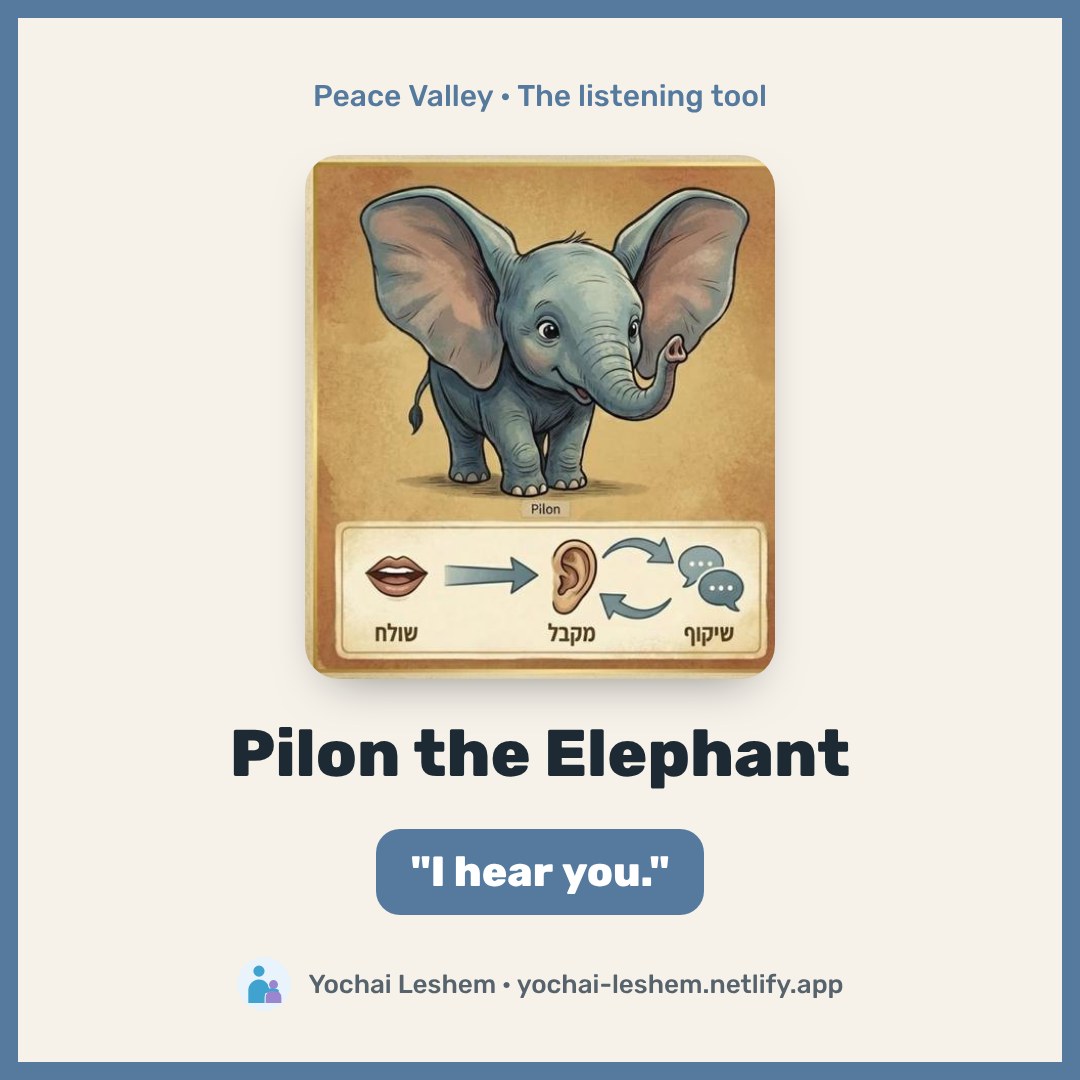
Pilon the Elephant
The listening tool"I hear you."Listening isn't just keeping quiet until it's my turn. Pilon spreads his big ears and repeats what the other side said. The moment a child hears his own words coming back to him from his brother or sister, something in him settles. He feels understood, and the anger gets smaller.
In the middle of a fight: "Now it's your turn to be Pilon. What did you hear your sister say?"
Practice at home: Happy echo: everyone shares something that happened to them today, and the next person repeats it in their own words.
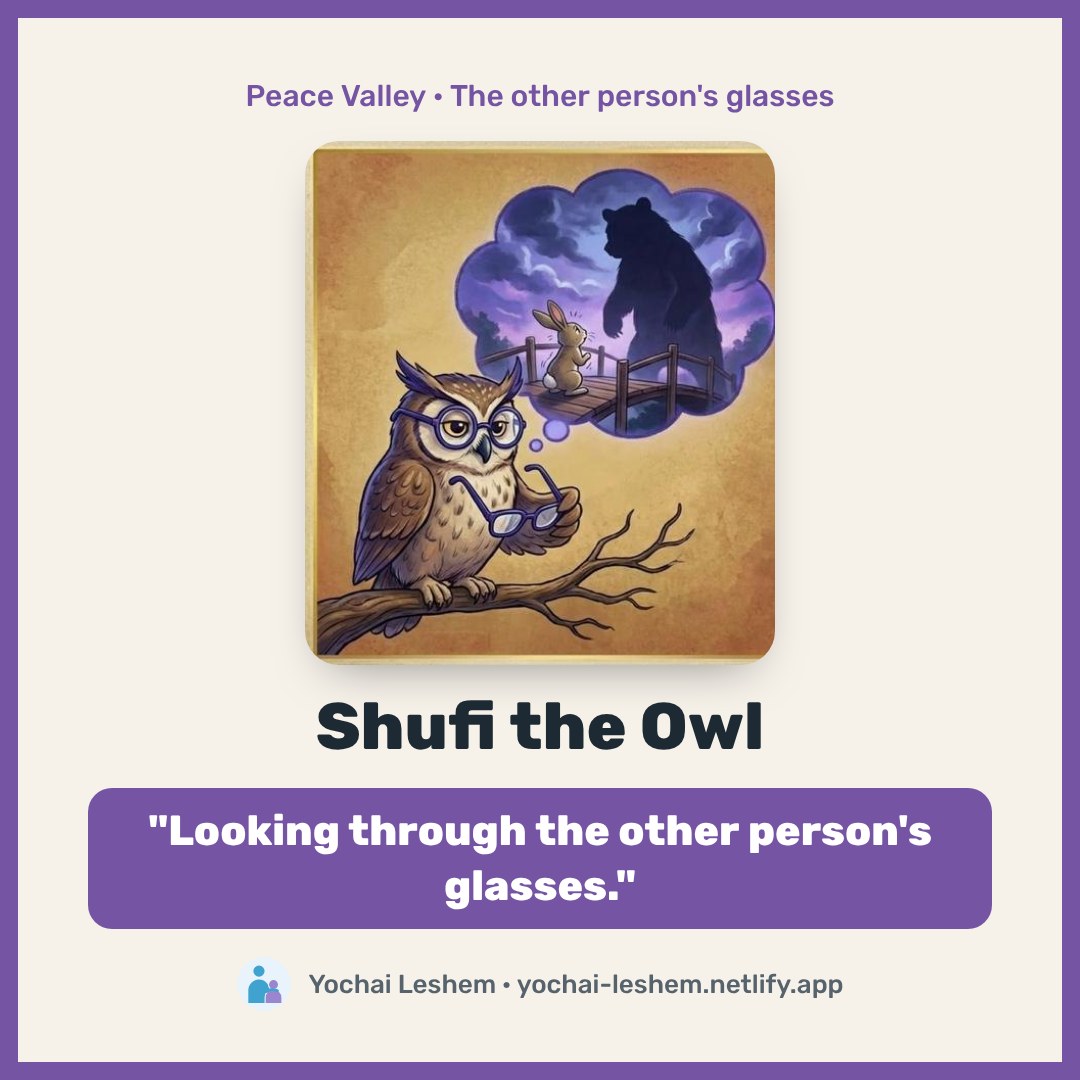
Shufi the Owl
The other person's glasses"Looking through the other person's glasses."Every story has two sides. Shufi the Owl takes out special glasses, and whoever puts them on sees the world from their friend's side. In the story, Dan the Bear puts on Roni the Rabbit's glasses and realizes she isn't being stubborn, she's simply scared. That's empathy, in a child's language.
In the middle of a fight: "Shufi is asking: if you were in your brother's place right now, how would you feel?"
Practice at home: Switch chairs: act out an argument. When someone claps, you move to the other person's chair and explain why the other side is right.
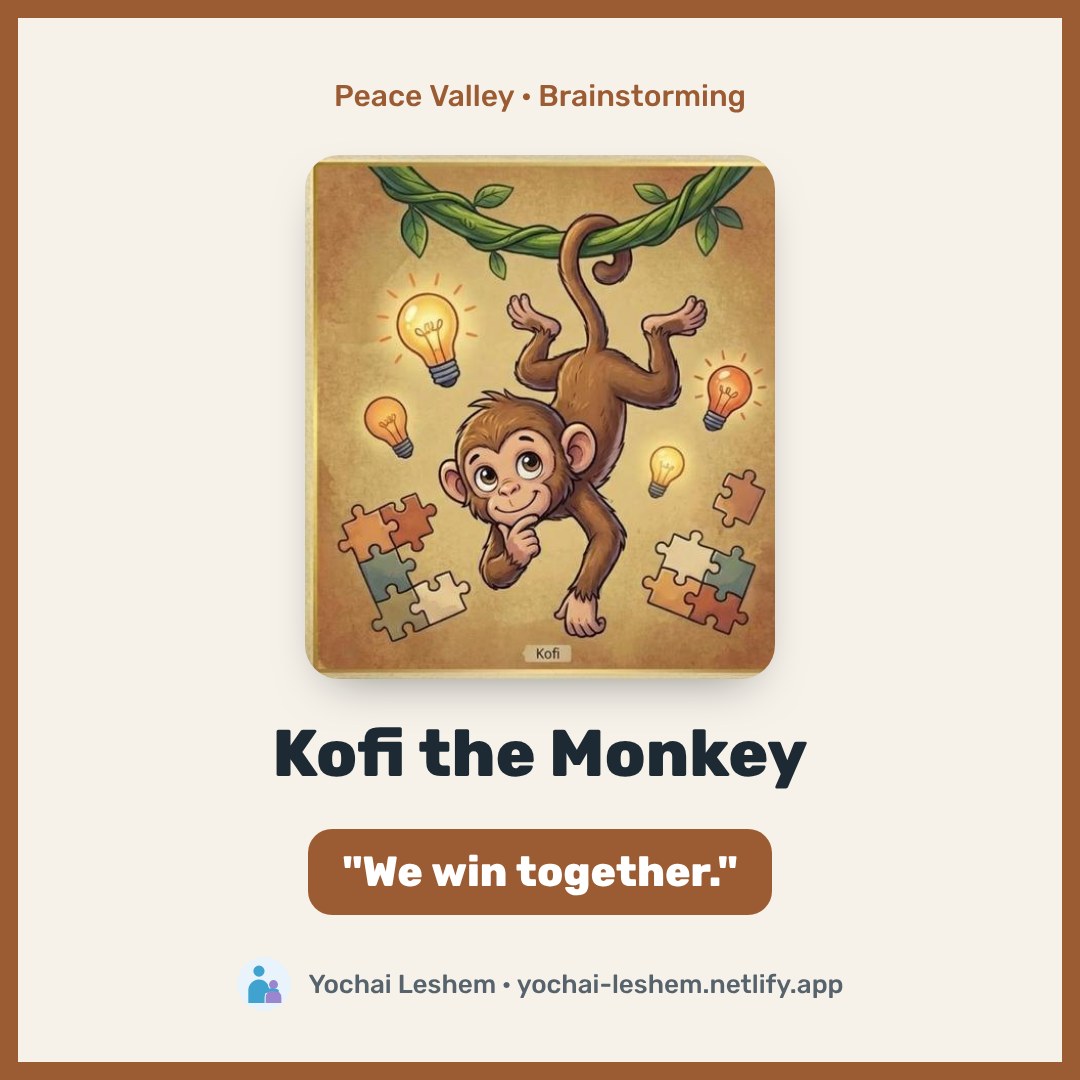
Kofi the Monkey
Brainstorming"We win together."Instead of fighting over who's right, Kofi swings above the bridge and tosses out ideas, even silly ones. The goal isn't for one of them to win, but to find a solution that's good for both. A child who finds a solution like that on his own learns that he can do it, and doesn't need a grown-up to decide for him.
In the middle of a fight: "Kofi is looking for a solution where you both win. Who has an idea?"
Practice at home: The idea machine: pick a real problem at home. Everyone suggests solutions, and no idea gets thrown out.
Yoni the Dove
The making-up tool"Forgive and start over."The fight is over, but hearts are still a little heavy. Yoni the Dove arrives with an olive leaf and reminds us that we also need to close things: a kind word, a sorry, a handshake or something fun to do together. Without this step, the anger stays under the surface, waiting for the next fight.
In the middle of a fight: "Yoni is waiting for us to let go of the anger. How do we finish: a handshake, a kind word or a decision together?"
Practice at home: An olive leaf round before Shabbat: everyone says a kind word or a sorry to someone in the family.
How to help a child grow up speaking the language of peace
Read the story and get to know the animals when everyone is calm. In the middle of a fight, you just use them.
Instead of a lecture, one sentence: "Let's be turtles for a moment." "How would Ari say that?"
"You stopped and breathed. That's the turtle's power." Children grow in the direction we look at them.
A parent who stops, breathes and says "I'm feeling tired" teaches more than any explanation. And we say sorry too.
A language is learned slowly. After a few weeks you'll hear a child tell his brother: "Say it like a lion."
A child who speaks the language of peace
The goal isn't a child who never fights. The goal is a child who, when he gets stuck on the bridge, knows what to do: stop, say what he feels, listen, see the other side, find a solution and make peace in his heart. He'll take this language with him to preschool, to the classroom, to his friendships, and one day to his own family too.
Save and share
A card for each animal. Save it, print it and stick it on the fridge, or send it to your parents' group.
Want to learn the method in depth?
In my Sibling Fights course, I teach in six short lessons how to stop being the judge, and how to use the Peace Valley bridge at home.
Go to the Sibling Fights course